

It may surprise many families how few student-athletes receive a full-ride athletic scholarship to play their sport in college. It's important to know that while you may not receive a full-ride athletic scholarship, you can still receive financial support from the programs you are interested in.
What's important to note is that when evaluating the different offers, you should choose the school that is the best fit for you holistically, not just where you are receiving the most money.
Let's break down the different offers you can receive from college programs as you narrow your list.
Full-Ride Scholarship Offers
A full-ride scholarship typically covers student tuition, fees, room and board, and course-related expenses such as books. If you receive a full-ride scholarship in your first year, it’s important to understand that there is no guarantee it will apply in the following years. Coaches must renew their scholarship annually.
Full-ride scholarships are available at the NCAA Division I level. Under the new NCAA settlement model, schools that have opted into the settlement may offer as many scholarships as they want, but must stay within strict roster caps. Previously, schools were limited by the number of scholarships. Now, they’re limited by the number of players on the roster. With the settlement, programs can offer a full-ride or a partial scholarship, and there is no minimum number of scholarships they need to provide.
Here’s a breakdown of new roster caps across key Division I sports. Please keep in mind that not all programs have opted into the NCAA Settlement.
NCAA DI Roster Caps
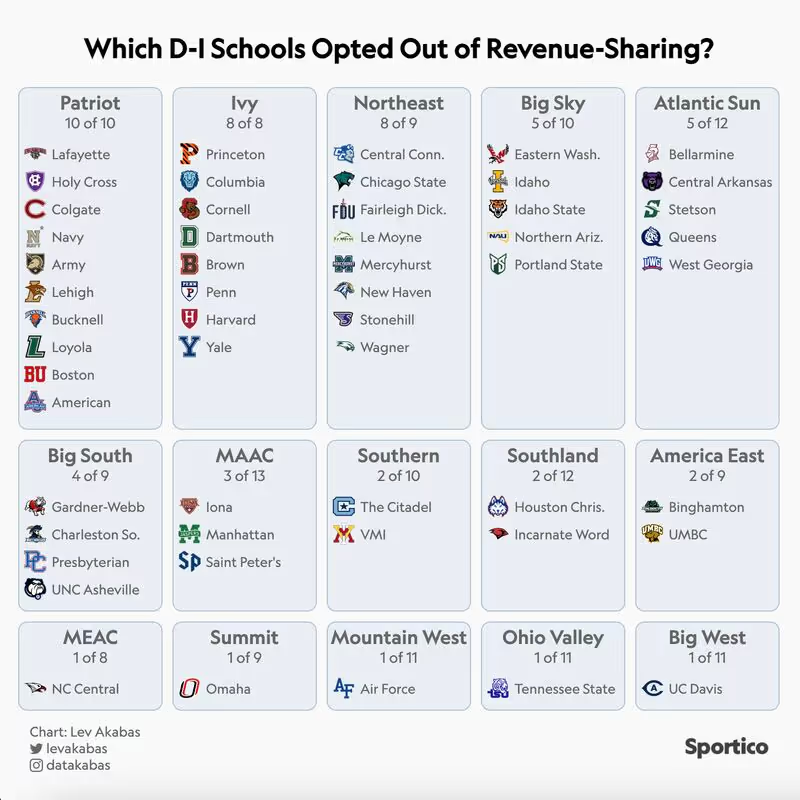
Programs not opted into the settlement will continue operating under the old scholarship and roster structure. This image, created by Sportico, provides a clear view of what Division I schools have opted out of revenue sharing, which means they do not need to abide by roster limits. (Note: Ivy League schools do not offer athletic scholarships)
- Men’s Basketball - Each team has 13 full-ride scholarships available.
- Football (FBS Only) - Each team has 85 full-ride scholarships available.
- Women’s Basketball - Each team has 15 full-ride scholarships available.
- Women’s Gymnastics - Each team has 12 full-ride scholarships available.
- Women’s Tennis - Each team has 8 full-ride scholarships available.
- Women’s Volleyball - Each team has 12 full-ride scholarships available.
Partial Athletic Scholarship Offers
Partial athletic scholarships are athletic scholarships available at NCAA Division I and Division II programs. Division I programs can offer full or partial scholarships
At the Division II level, each team has a specific amount of money to be offered that can be divided among as many players as they want. College coaches can decide how much they want to offer their student-athletes, so some student-athletes may receive more than others. Below is a list of NCAA equivalency sports and the number of scholarships available per sport, broken out by NCAA Division:
Men’s Division I Equivalency Scholarship Limits
This would only be for schools that opted out of the NCAA Settlement.
Women’s Division I Equivalency Scholarship Limits
This would only be for schools that opted out of the NCAA Settlement.
Men’s Division II Scholarship Limits
Women’s Division II Scholarship Limits
To illustrate how partial scholarships work, consider Division II women’s basketball. According to the chart, Division II teams get a maximum of 10 scholarships to divide across what is typically a 15-person roster. If each scholarship is worth $20,000, then the staff has the option to allocate $200,000 ($20,000 x 10 scholarships) across 15 athletes. They may choose to spread the entire $200,000 evenly across their top 10 recruits, though many coaches will instead opt to spread it more evenly across the entire team.
With partial scholarship offers, you can combine other types of aid to help cover the remaining cost of college. Student-athletes can combine financial aid, academic scholarships, merit-based scholarships, etc. Learn about the other ways you can pay for college in “Paying for College.”
Features of Partial Scholarships
- Partial cost coverage: Recipients receive a portion of the total cost of attendance, which means they may need to supplement the scholarship with other forms of financial aid.
- Divisible scholarships: Coaches can divide the total scholarship amount among multiple athletes to create a balanced team roster within the allocated budget.
- More opportunities: Due to the divisible nature of equivalency scholarships, more student-athletes have access to financial aid in sports with larger rosters.
Walk-On Offers
Not all student-athletes will earn an athletic scholarship when they receive a roster spot. Some student-athletes will also be offered walk-on positions. Knowing the differences between walk-on offers and athletic scholarship offers is essential as you narrow down your target list. With the introduction of roster limits as part of the new NCAA settlement, many have speculated that walk-on opportunities will be severely diminished due to less flexibility with roster sizes.
What is a Preferred Walk-On Offer?
This offer means you will receive a roster spot but no athletic scholarships. If you start as a preferred walk-on, that doesn’t necessarily mean you will never receive any athletic scholarship. Preferred walk-ons can earn athletic scholarship money for their second, third, or fourth season. Earning a scholarship will depend on how well you are playing and if your program has allotted money to give.
Being a preferred walk-on does not guarantee that you will receive a spot. If you aren’t performing up to the athletic standards of the team during tryouts, there is a chance you will be cut from the team. It’ll be crucial leading up to tryouts that you stay on top of your training to ensure you are in the best shape possible for tryouts!
What is a Recruited Walk-On Offer?
A recruited walk-offer means that there is interest from the coach, but you will need to earn a spot on the roster through additional tryouts.
What is an Unrecruited Walk-On Offer?
This type of offer is usually when a student is admitted into the school through academics and then reaches out to the coach to see if there are any open tryouts. If you are accepted into a school and are interested in playing for a program there, take the time to reach out to the coach and let them know you have been admitted and are interested in playing for their program. From there, the coach will be able to let you know if there are open tryouts. Open tryouts are likely to become less available with the new roster limits that each sport will be working under for schools that have opted into the NCAA Settlement.
The Different Color “Shirt Types” of College Sports
Redshirting, greenshirting, blueshirting, and grayshirting are terms used informally in recruiting and coaching circles to describe scholarship and roster timing decisions. They aren't official NCAA categories, and the NCAA's age-based eligibility model, adopted by the Division I Cabinet in June 2026, doesn't address most of them by name.
Redshirting
Redshirting is when a student-athlete sits out competition for a season while continuing to practice with the team. Coaches have historically used this year for injury recovery, skill development, or giving a young athlete time to adjust to college life.
Under the NCAA's previous four-seasons-in-five-years model, redshirting let a student-athlete preserve a season of competition to use later, effectively spreading four playable seasons across a five-year window. The NCAA's new age-based eligibility model removes that incentive for anyone it fully applies to. Your five-year eligibility clock now starts at enrollment, competition, or an age-based trigger tied to your 19th birthday, whichever comes first, and it runs continuously whether or not you compete. Sitting out a season no longer preserves anything to use later; that year still counts against your five-year window.
A coach might still choose to hold a true freshman out of competition for development reasons, but doing so does not extend how much eligibility that student-athlete has left. Student-athletes who enrolled in fall 2026 are a partial exception: their schools can apply whichever model, old or new, benefits them most, which is why a traditional redshirt year may still be available to that specific class. Starting with the fall 2027 class, that option is gone. See our guide to the NCAA's new age-based eligibility model for the full mechanics.
Greenshirting, Blueshirting, and Grayshirting
A greenshirt offer lets a student-athlete graduate high school early and enroll in December instead of the following fall, joining the team midyear so they can start practicing and competing sooner.
A blueshirt offer goes to an unrecruited student-athlete, meaning one who didn't take an official visit, receive a coach's visit at home, or signed an athletic aid agreement, and it includes an athletic scholarship starting in the student-athlete's first year even though they don't compete in games that season; it's uncommon, and programs typically use it to manage a roster that signed more student-athletes than it had scholarship room for.
A grayshirt offer delays a student-athlete's scholarship and official enrollment until their second semester rather than starting that fall, and the student-athlete can't practice, compete, or participate in team activities until they officially enroll.
None of these three describe an NCAA rule, so none of them come with a confirmed eligibility outcome under the new age-based model. What matters more than the label is when your five-year clock actually starts. NCAA.org confirms that happens at full-time enrollment, at competing for a college team even without full enrollment, or at the academic year after you turn 19, whichever comes first. Any decision that delays enrollment, whether or not someone calls it greenshirting, blueshirting, or grayshirting, delays your window by that same amount, and delaying past 19 shortens the window rather than extending it.
What about NCAA Division III?
NCAA Division III operates under its own separate eligibility structure and isn't affected by Division I's new age-based model; DIII continues to use a four-seasons-in-four-years framework. See our guide to the NCAA's new age-based eligibility model for how DI, DII, and DIII differ.
NCAA Division III programs are not able to provide athletic scholarships. However, they can extend walk-on offers or preferred walk-on offers to a recruit. Although NCAA DIII programs do not require student-athletes to sign a National Letter of Intent, the athlete may choose to sign a non-binding celebratory form upon acceptance to the college.
Build your student-athlete profile, upload unlimited video and build highlights, research schools, and gain recruiting exposure to college coaches free. Create your free SportsRecruits profile →